
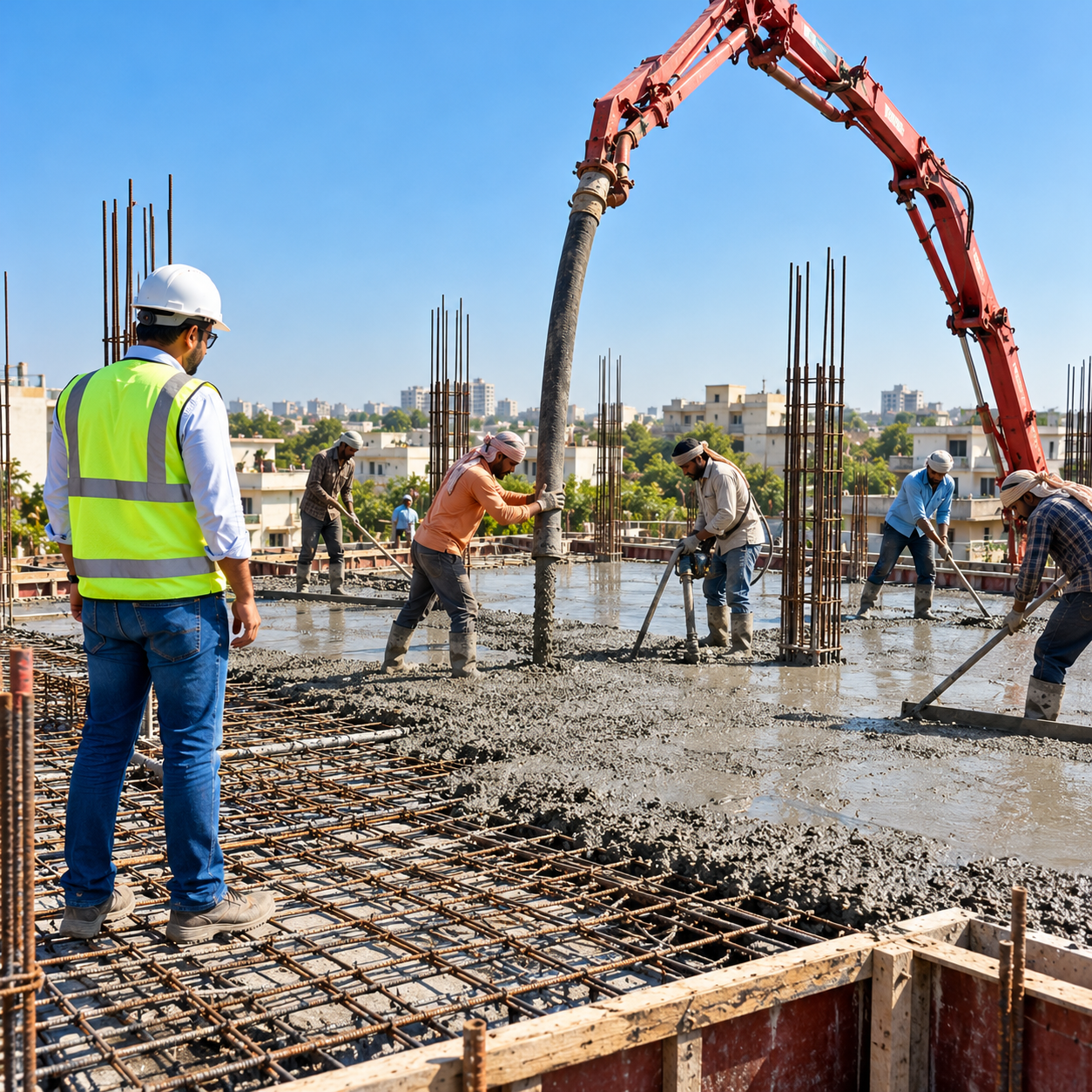
Constructing a multi-story residential building or luxury villa in Jaipur requires precision, high-grade materials, and rigorous structural engineering oversight. Among all structural milestones, roof slab casting is the most critical event in home construction. Traditionally, builders relied on manual site mixing using portable drum mixers and manual shovels. However, rapid urban growth across residential hubs like Vaishali Nagar, Mansarovar, Jagatpura, and Civil Lines has highlighted the severe limitations of manual mixing. Today, utilizing pre mix concrete—commonly known as Ready-Mix Concrete (RMC)—has become the gold standard for structural reliability and speed.
Choosing pre mix concrete for slab casting eliminates human error, guarantees precise water-cement ratios, and delivers homogeneous structural density that protects against long-term moisture ingress and cracking. This comprehensive guide explores 10 essential engineering steps and advantages of adopting pre mix concrete for your residential slab casting project.
The Evolution of Slab Casting: Why Site-Mixed Concrete Falls Short
To appreciate the superiority of industrial concrete batching, one must understand why traditional site-mixed concrete often fails to meet modern engineering demands.
Inconsistent Proportions and Manual Measurement Errors
When concrete is mixed on-site using manual labor, measuring aggregates, sand, cement, and water with absolute accuracy is nearly impossible. Workers often measure materials using volume buckets rather than precise weight batches. Variations in moisture content within sand piles further distort the water-cement ratio. This inconsistency results in fluctuating concrete strengths across different sections of the same roof slab, compromising load distribution.
The Hidden Dangers of Site-Mixed Concrete Honeycombing
Manual mixing often leaves unblended cement lumps and trapped air pockets within the mortar. When poured around dense steel reinforcement cages, site-mixed concrete frequently forms “honeycombing”—hollow voids and aggregate segregation. These structural flaws invite water percolation, steel rebar oxidation, and eventual slab failure. Transitioning to pre mix concrete completely eliminates these vulnerabilities through automated, computer-controlled batching.
+--------------------------------------------------------------------+
|                PRE MIX CONCRETE ADVANTAGES MATRIX                  |
+--------------------------------------------------------------------+
|  1. Automated Batching  --> Computer-controlled aggregate weighing |
|  2. Uniform Strength    --> Guaranteed M20/M25/M30 compressive limits|
|  3. Speed & Efficiency  --> Continuous pumping eliminates delays   |
|  4. Zero Site Clutter   --> No sand/aggregate storage on narrow roads|
+--------------------------------------------------------------------+
Phase 1: Understanding Pre Mix Concrete Specifications and Standards
Selecting and ordering the correct concrete specification from a certified RMC plant requires careful technical planning.
Step 1: Selecting the Correct Grade (M20, M25, M30) for Residential Slabs
The first step when utilizing pre mix concrete for slab casting is specifying the exact structural grade required by your structural engineer. For standard G+1 or G+2 residential villas in Jaipur, M20 (20 MPa) or M25 (25 MPa) grade concrete is typically recommended. For heavy commercial structures or high-rise apartments, M30 or higher grades are utilized. Specifying the right grade ensures your roof slab withstands dead loads, live loads, and seismic forces without excessive deflection.
Step 2: Conformance to Bureau of Indian Standards (BIS) Guidelines
All industrial concrete production must strictly adhere to national safety benchmarks. Certified batching plants operate under quality control standards published by the Bureau of Indian Standards (BIS)
, specifically IS 456 for plain and reinforced concrete and IS 4926 for ready-mixed concrete production. Sourcing pre mix concrete from BIS-certified plants guarantees that cement content, fly ash ratios, and aggregate gradations meet legal safety requirements. To review our complete material quality standards, explore our Turnkey Construction Packages.
Step 3: Customizing Slump and Setting Time for Jaipur’s Climate
Jaipur’s intense summer temperatures can cause fresh concrete to lose its workability rapidly due to accelerated evaporation. When ordering pre mix concrete, site engineers must specify the required slump value (typically 125mm to 150mm for pumped concrete) and request specialized retarder admixtures. Retarders slow down initial setting times, ensuring that the concrete remains workable during transit from the batching plant to your construction site, even during peak summer afternoons.
Phase 2: Logistics, Batching Plant Precision, and Delivery
The transition of concrete from automated batching plants to your rooftop formwork requires synchronized logistical planning.
Step 4: Automated Batching Plant Precision vs Manual Labor
Unlike manual site mixing, industrial batching plants use digital load cells to weigh cement, coarse aggregates, fine sand, and water with exact gram-level precision. Chemical and mineral admixtures are added via automated dispensers. This computerized accuracy ensures that every cubic meter of pre mix concrete delivered to your site possesses identical compressive strength and durability characteristics.
Step 5: Transit Mixer Transport and Retarder Additive Management
Once batched, pre mix concrete is loaded into rotating transit mixer drums that rotate continuously during transit to prevent segregation and premature setting. Transit time must be carefully coordinated with local traffic conditions in Jaipur. Utilizing retarder chemicals ensures that the mix retains its plastic state for up to 3 to 4 hours, allowing seamless delivery across expanding residential zones like Jagatpura and Mansarovar without hardening inside the drum.
Step 6: Direct Boom-Placer Pumping vs Manual Bucket Lifting
Traditional construction methods relied on labor-intensive human chains passing concrete buckets up wooden scaffolding. This slow process created cold joints as earlier batches began setting before subsequent batches arrived. Modern delivery of pre mix concrete for slab casting utilizes high-pressure concrete pumps and mechanical boom placers. Concrete is pumped directly through pipeline networks onto the rooftop formwork at rates exceeding 30 to 45 cubic meters per hour, drastically accelerating casting time.
Phase 3: Execution Best Practices During Slab Pouring
Even the highest quality industrial concrete requires rigorous on-site execution discipline during placement and compaction.
Step 7: Formwork Preparation, Slurry Sealing, and Rebar Cover
Prior to the arrival of the concrete transit trucks, formwork shuttering must be inspected, braced, and sealed with heavy tape to prevent slurry leakage. TMT steel rebar cages must be elevated using polymer cover blocks (minimum 25mm thickness) to guarantee complete encasement by the incoming pre mix concrete. Exposed steel rebar touching shuttering boards quickly rusts and compromises structural longevity.
Step 8: Mechanical Needle Vibration and Air Void Elimination
Although pre mix concrete possesses high workability, mechanical compaction remains mandatory. Site workers must systematically use 25mm and 40mm needle vibrators across the entire slab area. Proper vibration consolidates the mix around tight beam junctions, removes trapped air bubbles, and eliminates honeycombing voids that invite moisture penetration and structural dampness.
+--------------------------------------------------------------------+
|               PUMPING & PLACEMENT EXECUTION PROTOCOL               |
+--------------------------------------------------------------------+
|  Pipeline Setup       --> Secure rigid steel lines & rubber hoses  |
|  Slump Verification   --> Test incoming batch slump (125-150mm)    |
|  Continuous Pour      --> Maintain steady flow to avoid cold joints  |
|  Surface Screeding    --> Level concrete to precise grade tolerances|
+--------------------------------------------------------------------+
Step 9: Slope-to-Drain Engineering and Continuous Pouring
Standing rainwater on a flat roof slab is a primary trigger for structural degradation. While finishing the top surface of the pre mix concrete, skilled masons must slope the slab toward rainwater downpipes, maintaining a minimum fall of 1:100. Furthermore, maintaining a continuous pouring schedule ensures that fresh batches bond homogeneously with preceding batches, preventing weak cold joint seams. To learn more about architectural planning and site supervision, read our guide on 11 Smart Home Construction Design Tips for a Better, Comfortable Home.
Phase 4: Curing and Long-Term Structural Integrity
The structural journey of industrial concrete concludes with diligent post-placement curing protocols.
Step 10: 21-Day Water Ponding and Protective Surface Curing
Because pre mix concrete achieves high early strength, proper moisture retention is vital to prevent thermal shrinkage cracking. The morning after slab casting, mortar bunds should be constructed across the roof deck to create shallow water retention ponds. Submerging the slab under 2 inches of clean water for 14 to 21 consecutive days allows complete cement hydration. Thorough pond curing ensures that your pre mix concrete slab achieves its maximum design strength, protecting your building against cracking and structural fatigue. You can explore fundamental material science principles on the Wikipedia Ready-Mix Concrete page
. To review our engineering team’s credentials, visit our About Us and Project Handover Team.
Build Your Durable Home with Professional Concrete Solutions
Transitioning to industrial concrete mix standards revolutionizes residential construction quality. By eliminating manual batching errors, ensuring precise IS code compliance, and accelerating slab execution speed, pre mix concrete safeguards your property investment against structural defects, dampness, and premature aging.
Build Your Dream Home in Jaipur with Unmatched Structural Strength! Partner with RK Architect & Engineers—Jaipur’s trusted residential and commercial construction firm. We provide expert architectural planning, fixed-cost turnkey execution, and strict civil engineering supervision utilizing advanced pre mix concrete solutions across Vaishali Nagar, Mansarovar, Jagatpura, and Civil Lines. Contact RK Architect & Engineers Today for a Free Construction Consultation!
Frequently Asked Questions
Q1: Why is pre mix concrete superior to manual site mixing for roof slabs?
A: Pre mix concrete is produced in automated batching plants with digital weight sensors, ensuring exact material proportions, consistent water-cement ratios, and zero manual measurement errors, which guarantees superior structural strength and uniform density.
Q2: What concrete grade is best suited for residential slab casting in Jaipur?
A: For standard G+1 or G+2 residential villas, M25 grade pre mix concrete is typically recommended by structural engineers to ensure optimal load-bearing capacity and seismic resistance.
Q3: Does pre mix concrete dry too quickly during Jaipur’s hot summer months?
A: While high temperatures accelerate evaporation, RMC plants mix specialized retarder admixtures into pre mix concrete to control setting times, ensuring the mix remains workable during transport and placement even in peak summer weather.